K2F-C-3
DUSt3R: Geometric 3D Vision Made Easy
- Description: DUSt3R paper note — the pointmap-regression paradigm: from two uncalibrated images, directly regress two pointmaps (per-pixel 3D coords) both expressed in the first image's frame, with no camera poses or intrinsics as input. A Siamese ViT encoder + two cross-attention decoders + DPT heads (initialized from CroCo); a lightweight global alignment fuses many pairs into one scene. Recovers depth, matches, intrinsics, and poses from the pointmaps — replacing the classical SfM/MVS pipeline. The direct precursor of VGGT
- My Notion Note ID: K2F-C-3
- Created: 2026-08-02
- Updated: 2026-08-02
- License: Free to share: please credit Yu Zhang and link back to yuzhang.io
Table of Contents
- 1. Summary
- 2. Key Contributions
- 3. Method
- 4. Experiments & Results
- 5. Strengths / Limitations / Legacy
- References
1. Summary
Title: DUSt3R: Geometric 3D Vision Made Easy Authors: S. Wang (Aalto University); V. Leroy, Y. Cabon, B. Chidlovskii, J. Revaud (NAVER LABS Europe) Paper: arXiv:2312.14132 (CVPR 2024) Github: naver/dust3r
DUSt3R (Dense Unconstrained Stereo 3D Reconstruction) — turn a pair of images into 3D by directly regressing pointmaps, with no camera calibration and no known poses. It is the paradigm shift the whole VGGT line descends from.
Core problem: classical 3D reconstruction (SfM + MVS) is a brittle pipeline of many separately-solved subproblems — feature matching, triangulation, bundle adjustment, pose estimation, dense stereo — where errors in one stage cascade. And each stage needs known/estimated camera parameters. Learning-based methods still mostly slot into this pipeline rather than replace it.
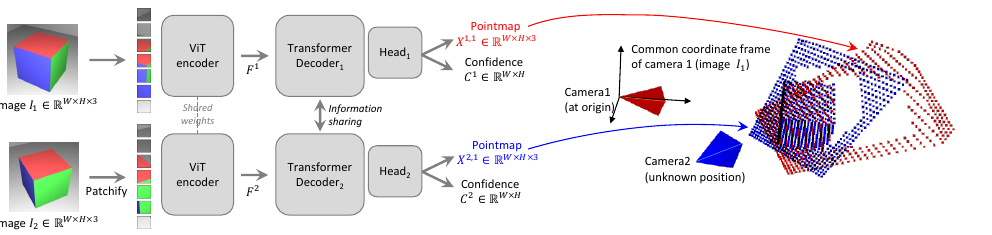
Key idea — the pointmap: instead of predicting depth (which needs intrinsics to become 3D) or matches (which need triangulation), predict a pointmap : a dense per-pixel map of 3D coordinates, one 3D point per pixel. Regress two pointmaps from two images — and crucially express both in the first image's coordinate frame. That single choice folds relative pose, depth, and correspondence into one representation: two images' pointmaps in a shared frame are already a registered two-view reconstruction.
Radical simplification: DUSt3R takes the "generalized stereo" problem — two images, unknown everything — and solves it by direct regression, learning all geometric priors from data rather than enforcing a camera model. Everything downstream (depth, matches, focal length, relative/absolute pose) is then read off the pointmaps by simple post-processing.
Main results: from uncalibrated, unposed images DUSt3R does monocular & multi-view depth, camera intrinsics, relative & absolute pose, and dense reconstruction — often beating task-specific methods — with a single network + a fast global-alignment step (pair inference ≈ 40 ms on an H100).
2. Key Contributions
- Pointmap regression as the interface — recast two-view 3D reconstruction as directly regressing per-pixel 3D pointmaps, sidestepping explicit camera models and the SfM/MVS stage pipeline.
- Both pointmaps in one frame — expressing the two views' pointmaps in the first image's frame makes the output an already-aligned two-view reconstruction, from which pose/depth/matches/intrinsics all follow.
- Global alignment — a fast optimization that stitches many pairwise pointmaps into one globally consistent scene (a lightweight, differentiable stand-in for bundle adjustment).
- A generic architecture with strong pretraining — a CroCo-style ViT encoder + cross-attention decoders that inherits CroCo pre-training, letting a task-agnostic net beat task-specific ones.
3. Method
3.1 Pointmaps
A pointmap associates each pixel with a 3D point. Given intrinsics and a depthmap , the pointmap in the camera frame is . Write for camera 's pointmap expressed in camera 's frame:
= world-to-camera poses, = homogeneous mapping . (This is only how ground-truth pointmaps are built for training — at inference DUSt3R regresses pointmaps directly, without or .)
3.2 Network: Encoder + Twin Decoders + Heads
Input: two RGB images . Output: two pointmaps (both in 's frame) + confidence maps . Architecture (inspired by, and initialized from, CroCo):
- Siamese ViT encoder (shared weights): , .
- Two intertwined transformer decoders that constantly exchange information via cross-attention. Each decoder block does: self-attention (tokens attend within their own view) -> cross-attention (tokens attend to the other view's tokens) -> MLP:
initialized , . This constant cross-view sharing is what makes the two output pointmaps come out aligned in one frame.
- Two DPT regression heads output the pointmaps + confidence from the decoder tokens.
Backbone: ViT-Large encoder, ViT-Base decoder, DPT head. The architecture enforces no geometric constraints — pointmaps needn't correspond to any physical camera model; the network learns geometric priors purely from geometrically-consistent training data.
3.3 Training Objective
3D regression loss — Euclidean distance between predicted and ground-truth pointmaps, each normalized by a scale factor (average distance of valid points to the origin) to handle scale ambiguity:
= view, = predicted / GT scale normalizers. Confidence-aware loss — the net also predicts a per-pixel confidence and is trained with:
The term rewards confidence, so the net down-weights ill-defined pixels (sky, translucent, single-view regions) without explicit supervision for confidence.
3.4 What Pointmaps Give You
Because both pointmaps live in 's frame, standard quantities are read off by simple post-processing:
- Point matching — nearest-neighbor (reciprocal / mutual) search in 3D pointmap space.
- Intrinsics — solve for focal from (assuming centered principal point, square pixels) via a fast iterative (Weiszfeld) solver.
- Relative pose — compare by Procrustes alignment (closed form), or more robustly via PnP-RANSAC on 2D-3D correspondences.
- Absolute pose (localization) — estimate query intrinsics from , get 2D-3D correspondences to a reference image, run PnP-RANSAC.
3.5 Global Alignment for Many Views
only handles a pair; a fast post-processing optimization fuses images into one frame. Build a connectivity graph (vertices = images, edges = overlapping pairs, found by retrieval or by running and thresholding pair confidence). For each edge predict pairwise pointmaps, then optimize global pointmaps with a per-pair pose and scale :
with to avoid the trivial solution. Unlike bundle adjustment this optimizes in 3D pointmap space (not 2D reprojection), so it is fast and simple; camera parameters fall out of the aligned .
4. Experiments & Results
Training data: 8.5M pairs from many datasets (Habitat, MegaDepth, ARKitScenes, ScanNet++, Waymo, …) spanning indoor/outdoor/synthetic/object-centric; pairs extracted via image retrieval + point matching when not provided. Progressive resolution 224×224 -> 512-px (largest dim), randomized aspect ratios so the net sees varied shapes at test time. ViT-Large encoder + ViT-Base decoder + DPT head.
Results: across monocular & multi-view depth, camera intrinsics, relative & absolute pose (visual localization), point matching, and dense multi-view reconstruction, DUSt3R is competitive with or beats task-specific methods — all from uncalibrated, unposed input, with a single network + global alignment. Pair inference ≈ 40 ms on an H100.
5. Strengths / Limitations / Legacy
Strengths
- A genuine paradigm shift: one regression target (pointmaps in a shared frame) collapses matching + triangulation + pose + depth into one learned step, killing the brittle SfM/MVS cascade.
- No calibration/poses required at input — works on casual, in-the-wild image pairs.
- Everything downstream is derived from the pointmaps, so one model serves many tasks.
- Rides CroCo pre-training — generic architecture + strong pretext beats specialized designs.
Limitations
- Fundamentally pairwise; scenes need a separate global alignment optimization, whose cost grows with the number of pairs (and it's still an optimization, not pure feed-forward).
- Pointmaps are scale-ambiguous and unconstrained by any camera model (can be geometrically implausible where data priors are weak).
- ViT-Large at ≤512 px — resolution and memory bounded; many-view scenes are a graph of pairs, not a joint model.
Legacy (why it's the immediate precursor to VGGT)
- DUSt3R establishes pointmaps as the output representation and proves feed-forward regression can replace SfM. Its main remaining seam is that it's two-view + a post-hoc global-alignment optimization.
- VGGT removes exactly that seam: a single feed-forward transformer ingests N images at once (via alternating frame-wise / global attention) and predicts cameras, depth, pointmaps, and tracks jointly — no pairwise decomposition, no global-alignment optimization. DUSt3R is the "why pointmaps / why no COLMAP" note; VGGT is "now do it for all views in one pass". (MASt3R and MASt3R-SfM are the intermediate steps adding metric pointmaps + matching + full SfM.)
References
- Wang, S., Leroy, V., Cabon, Y., Chidlovskii, B., & Revaud, J. (2024). DUSt3R: Geometric 3D Vision Made Easy. CVPR. arXiv:2312.14132, code. — source paper (Fig. 2 architecture above)
- CroCo / CroCo v2: the pre-training and encoder/decoder DUSt3R initializes from and repurposes — read first
- DPT: the regression head producing the dense pointmaps
- Leroy, V., Cabon, Y., & Revaud, J. (2024). Grounding Image Matching in 3D with MASt3R. ECCV. — follow-up adding a metric pointmap + dense matching head (the "M" = matching)
- VGGT: the successor — one feed-forward pass over all views, no pairwise global alignment