K2F-B-1
Transformer: Attention Is All You Need
- Description: Transformer paper note — the sequence model that drops recurrence and convolution entirely and computes representations purely from (self-)attention: scaled dot-product + multi-head attention, positional encodings, encoder-decoder stacks; new WMT'14 SOTA BLEU at a fraction of the training cost, and the backbone every later architecture (BERT, ViT, CroCo, DUSt3R, VGGT) builds on
- My Notion Note ID: K2F-B-1
- Created: 2026-08-02
- Updated: 2026-08-02
- License: Free to share: please credit Yu Zhang and link back to yuzhang.io
Table of Contents
- 1. Summary
- 2. Key Contributions
- 3. Method
- 4. Why Self-Attention
- 5. Experiments & Results
- 6. Strengths / Limitations / Legacy
- References
1. Summary
Title: Attention Is All You Need Authors: A. Vaswani, N. Shazeer, N. Parmar, J. Uszkoreit, L. Jones, A. N. Gomez, Ł. Kaiser, I. Polosukhin (Google Brain / Google Research / U. Toronto) Paper: arXiv:1706.03762 (NIPS 2017 — pre-NeurIPS rename) Github: tensorflow/tensor2tensor (official reference implementation)
Transformer — a sequence transduction model built entirely on attention, with no recurrence (RNN) and no convolution. Originally for machine translation; it became the universal backbone of modern deep learning.
Core problem: RNN-based sequence models (LSTM/GRU seq2seq) are inherently sequential — computation at step needs the hidden state from , so training cannot be parallelized across positions and long sentences are slow. Attention was already used alongside RNNs to connect distant positions; the paper's bet is that attention alone suffices.
Key idea: replace recurrence with self-attention — every position attends to every other position in one step. This gives (a) full parallelism across positions and (b) a constant path length between any two tokens, so long-range dependencies are easy to learn (an RNN needs steps to connect tokens apart; self-attention needs ).
The building blocks:
- Scaled dot-product attention — the core operation: weight each value by the (scaled, softmaxed) dot product of a query with each key.
- Multi-head attention — run several attention functions in parallel in different learned subspaces, so the model attends to different kinds of relations at once.
- Positional encoding — since attention is permutation-invariant, inject token order via fixed sinusoids added to the embeddings.
- Everything wrapped in residual connections + layer normalization, with a position-wise feed-forward network per layer.
Main results: new state of the art on WMT'14 — 28.4 BLEU EN→DE (big model, +2.0 over the best prior including ensembles) and 41.8 BLEU EN→FR — trained in 3.5 days on 8 GPUs, a small fraction of prior SOTA training cost.
2. Key Contributions
- The Transformer architecture — the first transduction model relying entirely on self-attention, no RNN/CNN.
- Scaled dot-product + multi-head attention — a cheap, highly parallel attention formulation with the scaling that keeps softmax gradients healthy at large dimension.
- Sinusoidal positional encoding — order information without recurrence, chosen so relative offsets are linear functions of position (may extrapolate to longer sequences).
- Demonstrated that parallelism + short paths win — SOTA translation at a fraction of training cost, launching the "attention-only" era.
3. Method
3.1 Encoder–Decoder Stacks
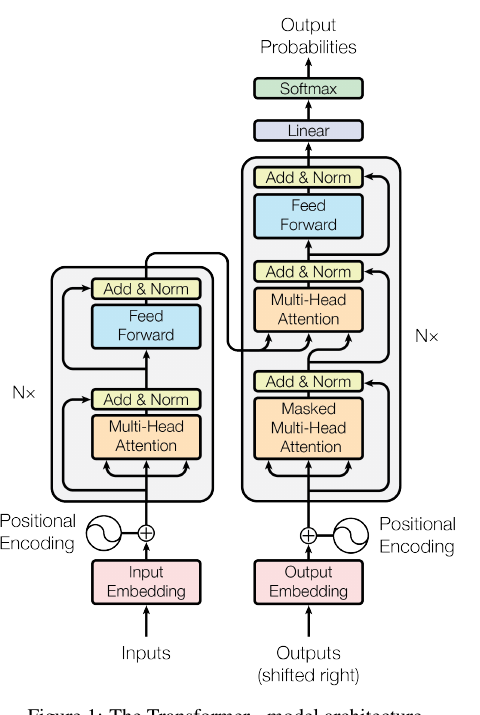
Standard encoder–decoder: the encoder maps input tokens to continuous representations ; the decoder generates output one token at a time, auto-regressively (each new token conditions on previously generated ones).
- Encoder: identical layers, each = [multi-head self-attention] + [position-wise feed-forward]. Each sub-layer is wrapped as (residual + layer-norm). All sub-layers and embeddings output dimension .
- Decoder: layers, each adding a third sub-layer — multi-head attention over the encoder output (cross-attention). Its self-attention is masked so position can only attend to positions , preserving the auto-regressive property (no peeking at future tokens).
3.2 Scaled Dot-Product Attention
Attention maps a query and a set of key–value pairs to an output = a weighted sum of the values, where each weight is a compatibility score between the query and that value's key. Packed into matrices :
= queries, = keys (both dimension ), = values (dimension ); = all query–key dot products, softmax over each row gives the attention weights, which mix the values.
Why the scaling: for large the dot products grow in magnitude (with unit-variance components, has variance ), pushing softmax into saturated regions with tiny gradients. Dividing by counteracts this. Dot-product attention (vs additive attention) is chosen because it's a single matrix multiply — fast and memory-efficient.
3.3 Multi-Head Attention
Instead of one attention over -dim vectors, linearly project into lower-dim subspaces, attend in each in parallel, concatenate, and project back:
, , are learned projections. Different heads attend to different representation subspaces at once — a single head would average these together and lose that. The paper uses heads with , so total cost ≈ single full-dim head.
3.4 Where Attention Is Used
Three uses of multi-head attention:
- Encoder self-attention — Q, K, V all from the previous encoder layer; every position attends to all positions.
- Decoder masked self-attention — attends to earlier decoder positions only; illegal (future) connections masked to before softmax.
- Encoder–decoder (cross-)attention — queries from the decoder, keys/values from the encoder output; lets each decoder position attend over the whole input. (This cross-attention is the direct ancestor of the "global attention across views" in multi-view 3D transformers.)
3.5 Feed-Forward, Embeddings, Positional Encoding
- Position-wise FFN — applied identically to each position: two linear layers with ReLU, ; inner dimension .
- Embeddings — learned token embeddings of dim ; input embeddings, output embeddings, and the pre-softmax projection share weights (embeddings scaled by ).
- Positional encoding — added to embeddings so the model knows token order. Fixed sinusoids of geometric wavelengths ( to ):
= position, = dimension index. Chosen so is a linear function of for any fixed offset (easy relative-position attention) and to potentially extrapolate beyond training lengths. Learned positional embeddings gave near-identical results (Table 3 row E).
4. Why Self-Attention
Three desiderata compared across layer types (Table 1; = sequence length, = representation dim):
| Layer type | Complexity / layer | Sequential ops | Max path length |
|---|---|---|---|
| Self-Attention | |||
| Recurrent | |||
| Convolutional | |||
| Self-Attention (restricted, neighborhood ) |
Self-attention wins on sequential operations (fully parallel, ) and path length ( — any two positions directly connected). It is also cheaper than recurrence per layer when (usually true for sentence representations). Bonus: attention heads are somewhat interpretable, appearing to learn syntactic/semantic structure.
5. Experiments & Results
Task / data: WMT'14 EN→DE (4.5M sentence pairs, ~37k shared BPE vocab) and EN→FR (36M sentences, 32k word-piece vocab). Trained on 8 × NVIDIA P100 GPUs. Base: 100k steps (~12 h); Big: 300k steps (~3.5 days). Adam with ; learning rate warmup over 4000 steps then inverse-sqrt decay; residual dropout 0.1; label smoothing 0.1. Beam size 4, length penalty 0.6.
Translation BLEU (newstest2014):
| Model | EN→DE BLEU | EN→FR BLEU | Train FLOPs (EN-DE) |
|---|---|---|---|
| GNMT + RL (ensemble) | 26.30 | 41.16 | ~1.8·10²⁰ |
| ConvS2S (ensemble) | 26.36 | 41.29 | ~7.7·10¹⁹ |
| Transformer (base) | 27.3 | 38.1 | 3.3·10¹⁸ |
| Transformer (big) | 28.4 | 41.8 | 2.3·10¹⁹ |
(FLOPs shown for EN-DE; the baselines' EN-FR training cost is ~6× higher (~10²¹). Transformer rows report a single combined FLOPs value.)
The big model sets a new EN→DE SOTA at 28.4 (+2.0 BLEU over the best prior, ensembles included) and EN→FR 41.8 (Table 2; note §6.1's prose quotes 41.0 — an in-paper inconsistency), both at far lower training cost. Even the base model beats all prior published single models.
Ablations (Table 3, newstest2013): single-head attention is 0.9 BLEU worse than , but too many heads also hurt; shrinking hurts (dot-product compatibility isn't trivial); bigger models and dropout both help; learned vs sinusoidal positional encodings ≈ identical. Config: base = 65M params; big = 1024, 4096, 16, 213M params.
6. Strengths / Limitations / Legacy
Strengths
- Removed the sequential bottleneck of RNNs → massively parallel training and short gradient paths; this is the reason large-scale pretraining became feasible.
- Conceptually minimal: attention + FFN + residual/LN + positional encoding, and it generalizes far beyond translation.
- Strong empirical case (SOTA at lower cost) plus clean ablations isolating each design choice.
Limitations
- attention in sequence length — quadratic memory/compute makes very long sequences expensive (spawning a whole line of "efficient Transformer" work).
- Fixed context; no built-in notion of locality or 2D structure — inductive bias must be learned from data (which is exactly why ViT later needs huge datasets).
- Positional encoding is a bolt-on rather than intrinsic.
Legacy (why this note is the root of the reading arc)
- BERT / GPT — encoder-only / decoder-only Transformers for language.
- ViT — applies the encoder verbatim to image patches; the entire vision-transformer lineage follows.
- CroCo → DUSt3R → VGGT — cross-view and multi-view 3D built on Transformer encoders + cross-attention; the "global attention across views" that VGGT relies on is this paper's cross-attention generalized to many images.
References
- Vaswani, A., Shazeer, N., Parmar, N., Uszkoreit, J., Jones, L., Gomez, A. N., Kaiser, Ł., & Polosukhin, I. (2017). Attention Is All You Need. NeurIPS. arXiv:1706.03762, code. — source paper (Fig. 1 architecture above)
- Bahdanau, D., Cho, K., & Bengio, Y. (2015). Neural Machine Translation by Jointly Learning to Align and Translate. ICLR. — additive attention alongside RNNs; the attention this paper makes standalone
- Hochreiter, S., & Schmidhuber, J. (1997). Long Short-Term Memory. Neural Computation. — the recurrent baseline Transformers replace
- Ba, J. L., Kiros, J. R., & Hinton, G. E. (2016). Layer Normalization. — the normalization used around each sub-layer
- ViT: the direct application of this encoder to vision, next in the reading arc